Category
Circular Economy · UX Design
Year
2024
Course
MBL 514E · DADS'24 · ITU
Instructors
Prof. Dr. Birgül Çolakoğlu · Assoc. Prof. Dr. Sevil Yazıcı
Collaborators
Batuhan Ünlü, İ.G., B.A.C.
Partner
Kadıköy Municipality
Tools
Figma · GIS · Data Analysis · UX Research
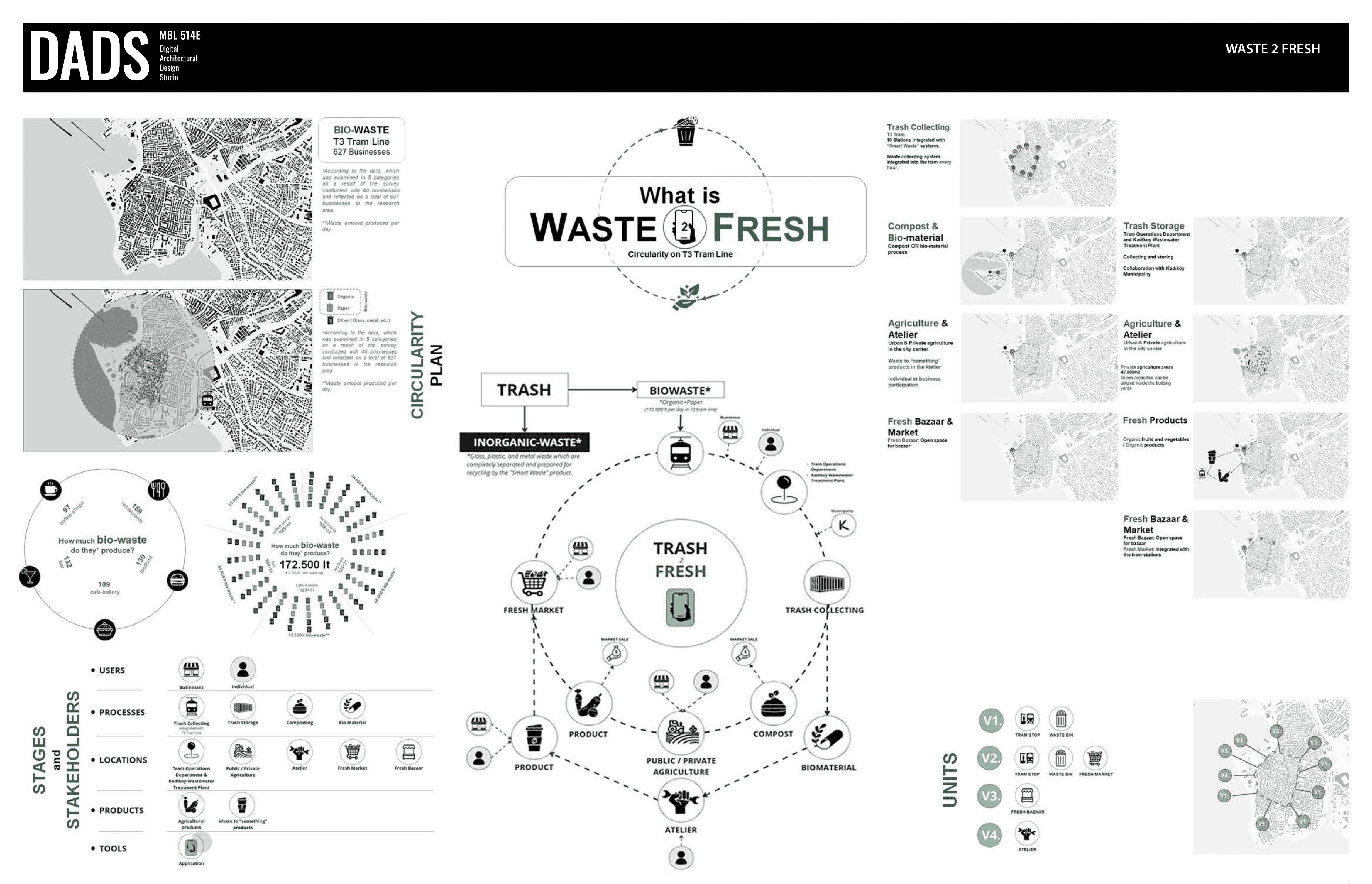
Waste2Fresh is a circular economy business model developed along the T3 Kadıköy-Moda tram line in Istanbul — transforming bio-waste from 627 businesses in the Caferağa district into compost, bio-materials, and fresh produce, reintegrated back into the same community that produced them.
Developed in DADS'24 at ITU in direct collaboration with Kadıköy Municipality, the project repurposes the T3 tram line as a waste collection vehicle — with containers attached to the rear of trains picking up bio-waste at 10 designated stops every hour via underground pneumatic vacuum transfer. The collected material is processed at the municipal wastewater treatment plant into compost and bio-materials, then redistributed through urban agriculture plots, workshop ateliers, and Fresh Market kiosks integrated into tram stops.
A companion mobile app — W2F — was designed in Figma to manage the full circular loop: waste drop-off tracking, QR scanning at collection points, workshop booking, fresh market browsing, and urban agriculture reservations. The UX design process — Empathize, Define, Ideate, Prototype — was directly informed by prior coursework in Google's UX Design certificate program, translating academic UX methodology into a fully functional interface for a real municipal context.
The System — Circularity Plan
T3 Tram Line · Kadıköy
Bio-Waste to Resource
A survey of 40 businesses — scaled to represent all 627 in the study area — revealed that approximately 60% of all waste produced is bio-waste: food scraps and paper. Coffee shops lead at 69%, followed by fast-food (64%), restaurants (63%), bars (58%), and bakeries (56%). This amounts to 172,500 litres of bio-waste per day — currently discarded without any circularity intervention.
The circularity plan connects four stages: Trash Collecting via tram-integrated vacuum transfer, Compost & Bio-material production at the wastewater treatment plant using 35 industrial composting machines, Agriculture & Atelier across urban and private growing areas and 3D-printed bio-material workshops, and Fresh Bazaar & Market — kiosks at tram stops and a fixed coastal market selling products grown entirely within Kadıköy.
How It Works — The Collection Pipeline

Tram-Integrated Collection
7-Step Circularity
Every hour, a 2.5m × 6m container is attached to the rear of the T3 tram. At 10 specified stops, underground pneumatic tubes use vacuum technology to transfer bio-waste from Smart Waste bins directly into the container — without the tram stopping its passenger service. When the tram completes its route at Damga Street, the full container is exchanged for an empty one and delivered to the municipal wastewater treatment plant via the existing tram control line.
Four module types define the physical system: V1 — tram stop integrated with waste bin; V2 — tram stop + waste bin + Fresh Market kiosk; V3 — Fresh Bazaar, a fixed market on the coastal line selling organic products; V4 — Atelier workshop units where individuals and businesses produce final bio-material products. All four units are accessible and manageable through the W2F app.
W2F App — UX Design & Prototype
Figma · Full Flow
App Flow

W2F Mobile App
Screen Mockups
The W2F mobile app was designed in Figma following the complete UX process — Empathize, Define, Ideate, Prototype — directly applying skills from Google's UX Design certificate program. The full flow covers onboarding, drop zone selection, QR scanning at collection points, cart checkout, workshop booking, urban farm reservation, and navigation to the nearest Fresh Market or Atelier.
The interface serves two user types: businesses — waste tracking, bio-material workshop access, bulk fresh product purchasing — and individuals — urban agriculture plot reservation, atelier participation, and fresh market browsing. The visual system uses a clean white UI with a green accent palette, reflecting the ecological mission of the product while maintaining clarity across all transaction flows.


Working Prototype — App Demo
The working prototype demonstrates the full user journey — from onboarding and drop zone selection through QR scanning at the tram stop, cart checkout, workshop booking, and navigation to the nearest Fresh Market or Atelier unit. The prototype was built to validate the interaction logic of the circular system end-to-end, from waste disposal to product purchase, within a single app session.