
Category
Game Landscape Design
Year
2020–2021
Course
PEM 368E · Digital Representation Techniques · ITU
Instructors
Dr. Ikhwan Kim · Res. Asst. Çisem Demirel
Collaborator
D.K.
Setting
World of Warcraft — Feralas, Kalimdor, Azeroth
Tools
3D Modeling · Diagram Layers · Character Design · Digital Representation
From the Talk
Metamesh Triennale #190 · 31:40
A landscape design proposal set inside the World of Warcraft universe — an underground zone conceived beneath the existing Camp Ataya area in Feralas, Kalimdor. Sparked by a semester-long exploration of the WoW world map, the project identifies a lack of spatial engagement in Camp Ataya and proposes an entirely new subterranean landscape to re-engage players with the area.
The Underworld is populated by bioluminescent flora drawn from real-world references in New Zealand cave ecosystems — worms, plants, and fungi that flourish in humid and dark conditions, making them ecologically plausible beneath Camp Ataya's underground lakes. Three distinct zones (Glitch Zone, Underworld City Hot, Underworld City Cold) surround a central Dark Zone, with the Dragon's Nest at the southern end.
The design was developed through five stacked master diagram layers covering player activity, story, natural environment, artificial environment, and media atmosphere — combined with 3D section models, perspective sketches, NPC character designs, and a three-quest narrative arc that structures the full player experience from entry to boss fight.
Design Concept — The Underworld of Camp Ataya
WoW Universe · Feralas
Why an Underworld?
Camp Ataya's aboveground environment is calm, predictable, and monotonous — qualities that disengage players over time. By choosing an underworld setting, the design breaks this surface entirely: introducing unexpected, claustrophobic, and non-monotonous spatial experiences that give players a reason to return to the area and engage with it on a completely new level.
The site is accessed by falling through a hole in the ground at the northeast edge of Camp Ataya — placed directly beneath the area's existing underground lakes, fed by groundwater. Bioluminescent worms and plants originally native to New Zealand were selected as the primary life source: organisms that thrive in humid, dark, sunless conditions — a perfect ecological fit for the Underworld.


The Underworld — Master Map
500m · 10×10m Grid
Spatial Organisation
The Underworld master map covers a 500-meter area on a 10m × 10m grid. Three major cave zones cluster around a central Dark Zone: the Glitch Zone (Tutorial Area) to the north, Underworld City Cold to the east, Underworld City Hot to the southwest, and the Dragon's Nest at the southern terminus. Each zone is connected by mud paths, water channels, and rock wall corridors.
The spatial hierarchy moves from disorientation to familiarity to confrontation — the Glitch Zone offers no minimap and high-level monsters, the Underworld Cities provide social NPC interaction and quest triggers, and the Dragon's Nest delivers the climactic boss encounter. The Tree of Wisdom serves as the landmark of the Cold City, anchoring the player's sense of place in the deepest part of the map.

Master Diagram Layers — 5 Stacked Systems
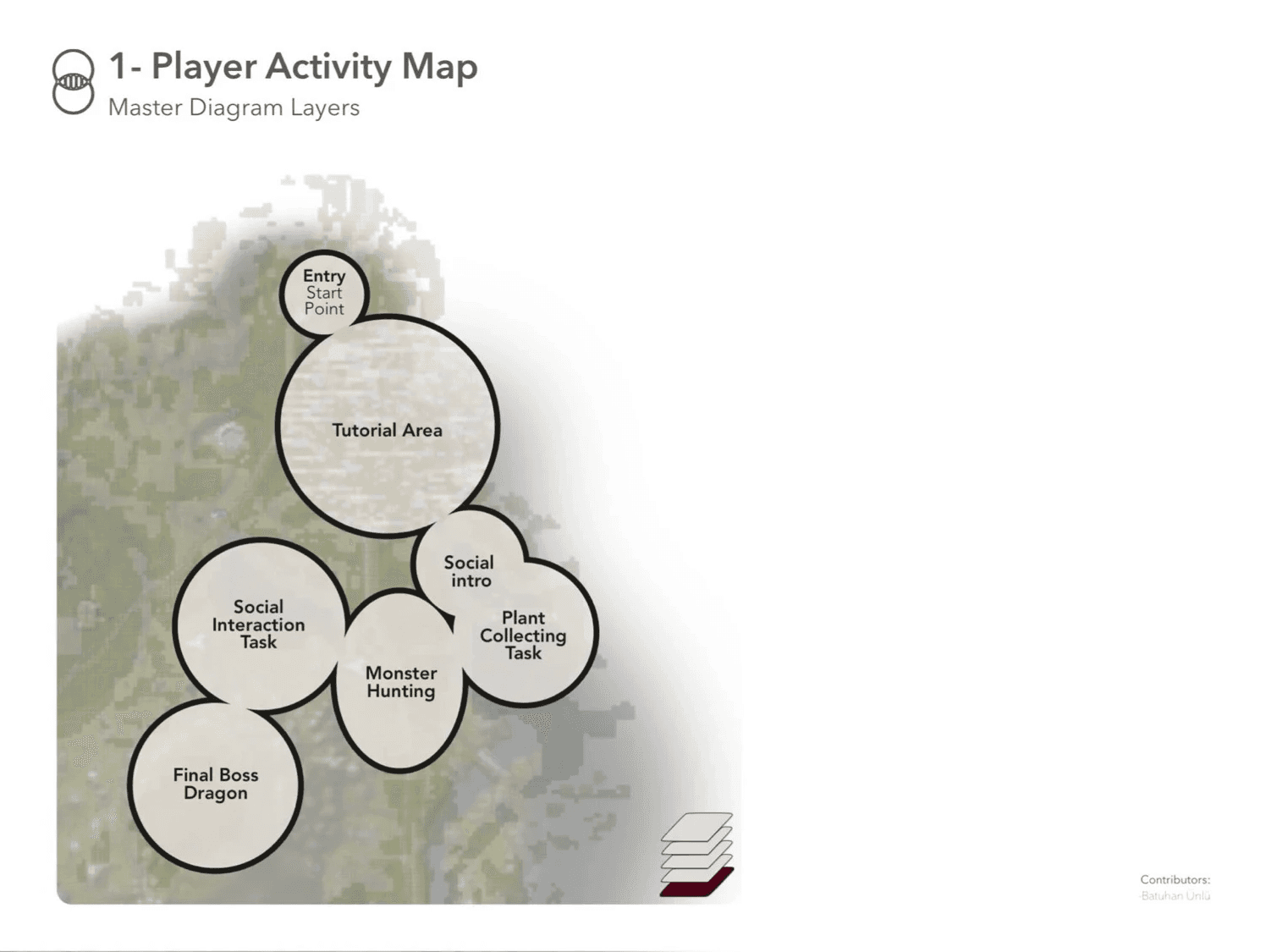


Player · Story · Nature · Artificial · Media
Five Diagram Layers
Five stacked master diagram layers define the complete spatial logic of the Underworld. Layer 1 — Player Activity maps the full movement sequence: Entry → Tutorial Area → Social Intro → Plant Collecting, Monster Hunting, Social Interaction → Final Boss Dragon. Layer 2 — Story annotates each zone with its narrative function: the tunnel entry as a fall into the unknown, Quest 1 triggering in the Tutorial Area, social introduction to Underworld City residents, and the Boss Fight at the Dragon's Nest.
Layer 3 — Natural Environment specifies all terrain materials: bioluminescent soil, rock walls, water paths, jump-scare voids, dead ends, dry mud roads of the Dark Zone, and the Tree of Wisdom. Layer 4 — Artificial Environment places all NPCs, stone roads, Gates of Underworld, huts, and the Wizard of Wisdom. Layer 5 — Media assigns atmospheric music zones: Dark Music in the Glitch Zone and Dark Zone, Epic Music in the Hot City and Dragon's Nest, Calm Music in the Cold City.
3D Sections — Spatial Experience
500m Scale
Section Cuts
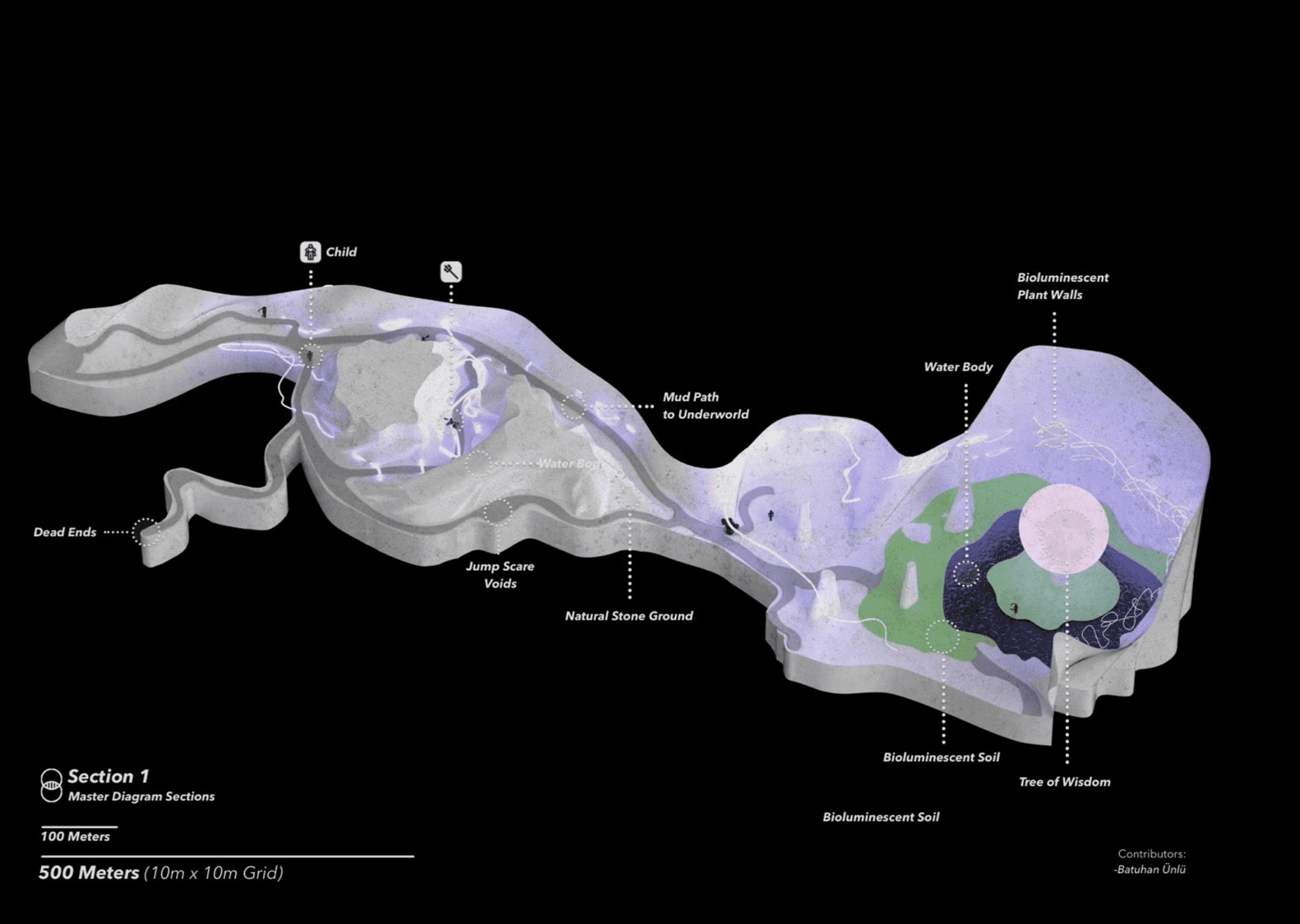
Section 1 cuts through the Glitch Zone and the Cold Underworld City at 500-meter scale — revealing the tunnel entry, jump-scare voids, water body, natural stone ground, bioluminescent soil layers, and the Tree of Wisdom glowing at the far right. The section annotates all terrain and landscape elements with dotted leader lines, establishing the full spatial depth of the northern half of the Underworld.

Section 2 isolates the Hot Underworld City and Dragon's Nest — showing dry mud roads of the Dark Zone, Dark Zone Spiders suspended above, Warriors of Underworld in the mid-ground, bioluminescent plant pools, water bodies, and the Dragon of the Underworld in its volcanic nest cavity. The section demonstrates the dramatic vertical contrast between the inhabited city level and the raw geological drama of the final boss zone.
Perspective Sketches — Ground Level Experience
Dark Zone · Dragon's Nest · Cold City
Into the Underworld
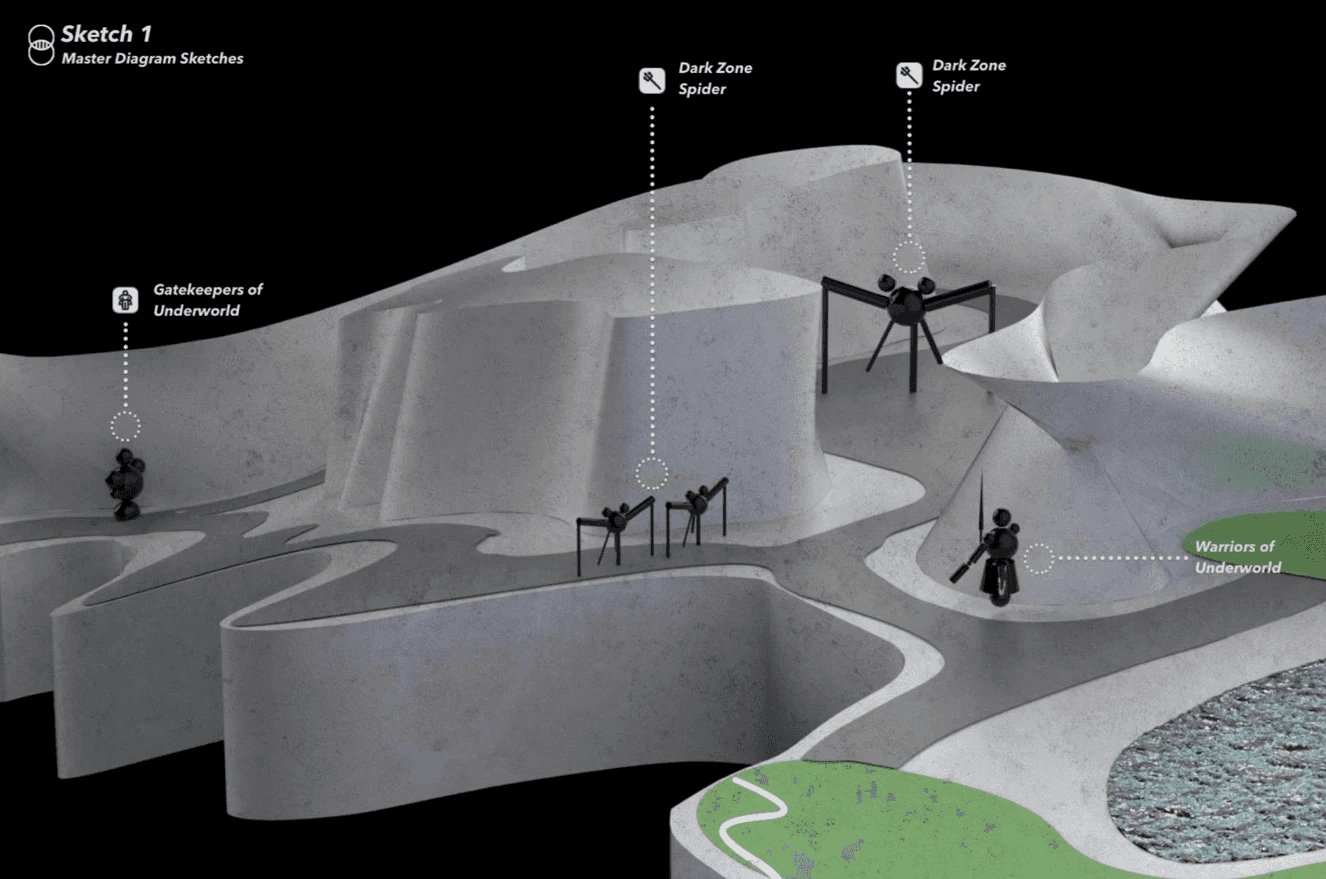
Three perspective sketch views bring the spatial experience to ground level. Sketch 1 enters the Dark Zone — Gatekeepers of Underworld stand at the entrance, Dark Zone Spiders loom above the path, Warriors of Underworld occupy the mid-ground, and a bioluminescent water pool fills the base. The composition is intentionally threatening and disorienting, communicating the hostile character of the zone.
Sketch 2 looks down into the Dragon's Nest from above — the Dragon of the Underworld dominates its volcanic crater while the Hot City below shows warriors, gatekeepers, bioluminescent plants, and water bodies. Sketch 3 opens into the Cold Underworld City — the Tree of Wisdom glows at center, bioluminescent plants line the cave walls, the Princess of Underworld and Gatekeepers stand along the path leading to the Wizard of Wisdom.


Quest Design — Three-Act Narrative
Player Journey
The Story of the Underworld
Quest 01
Help the Scared Kid
A lost child in the tunnels under Camp Ataya. No minimap, jump scares, monsters above your level. Bring her to safety and learn what's happening underground.
Reward: Bioluminescent Torch
Quest 02
Gather the Family
The royal family of the Underworld was divided by the Dark Zone. Bring the mother and daughter from Cold Underworld City to Warm City, collect 5 bioluminescent plants, and protect them from monsters.
Reward: Location of the Tree of Knowledge
Quest 03
Dragon Boss Fight
Collect the fighters of Warm Underworld City and march to the Dragon's Nest for a final confrontation. Defeat the Dragon of the Underworld to lead the Underworld people to the exit.
Reward: Sword of Underworld Royal Family
NPC Characters — The Underworld Cast
9 NPCs · 3D Maquettes
Character Models
Nine NPC character models populate the Underworld, visualized as white 3D maquettes at relative scale: Gatekeeper of Underworld, Princess of Underworld, Dark Humanoid, Jump Scare Monster, Dark Zone Spider — the large arachnid hostile of the tunnel zones — Warriors of Underworld in three combat variants, and the Dragon of the Underworld towering above all others as the final boss.
The player is designed to carry three layered emotions across the full journey: Compassion from rescuing the lost child in Quest 1, Companionship from uniting the divided Underworld family in Quest 2, and Heroism from defeating the Dragon and leading the Underworld people to the exit in Quest 3 — emotions that persist beyond the game experience.

Concept Art — Visual References & Illustrations
Illustrations · D.K.
Visions for the Underworld
Concept art illustrations by D.K. establish the visual vocabulary of the Underworld — the Tree of Wisdom as the Cold City's central landmark, bioluminescent plant environments lining the cave walls, the Hut of Villagers as a social anchor point, and the general underground atmosphere informed by New Zealand glowworm cave photography, Avatar's Pandora bioluminescent forest, and the Upside Down from Stranger Things.

Reflection
Virtual Landscapes · Studio Brief
Camp Ataya began as a 'virtual landscapes' studio brief — take a real place and reimagine it as a game level. The question became: what if the ground gives way and you descend into a subterranean world? How would the surface waters of Camp Ataya develop organically once they sink below — and how would light behave underground, where there is no sun to shape space? Drawing on bioluminescence — the glowing flora of Avatar's Tree of Life, real glow-worm caves — the project treats light itself as an architectural element, generated and placed through computational, analytical design.